03
The Idle God
 archive
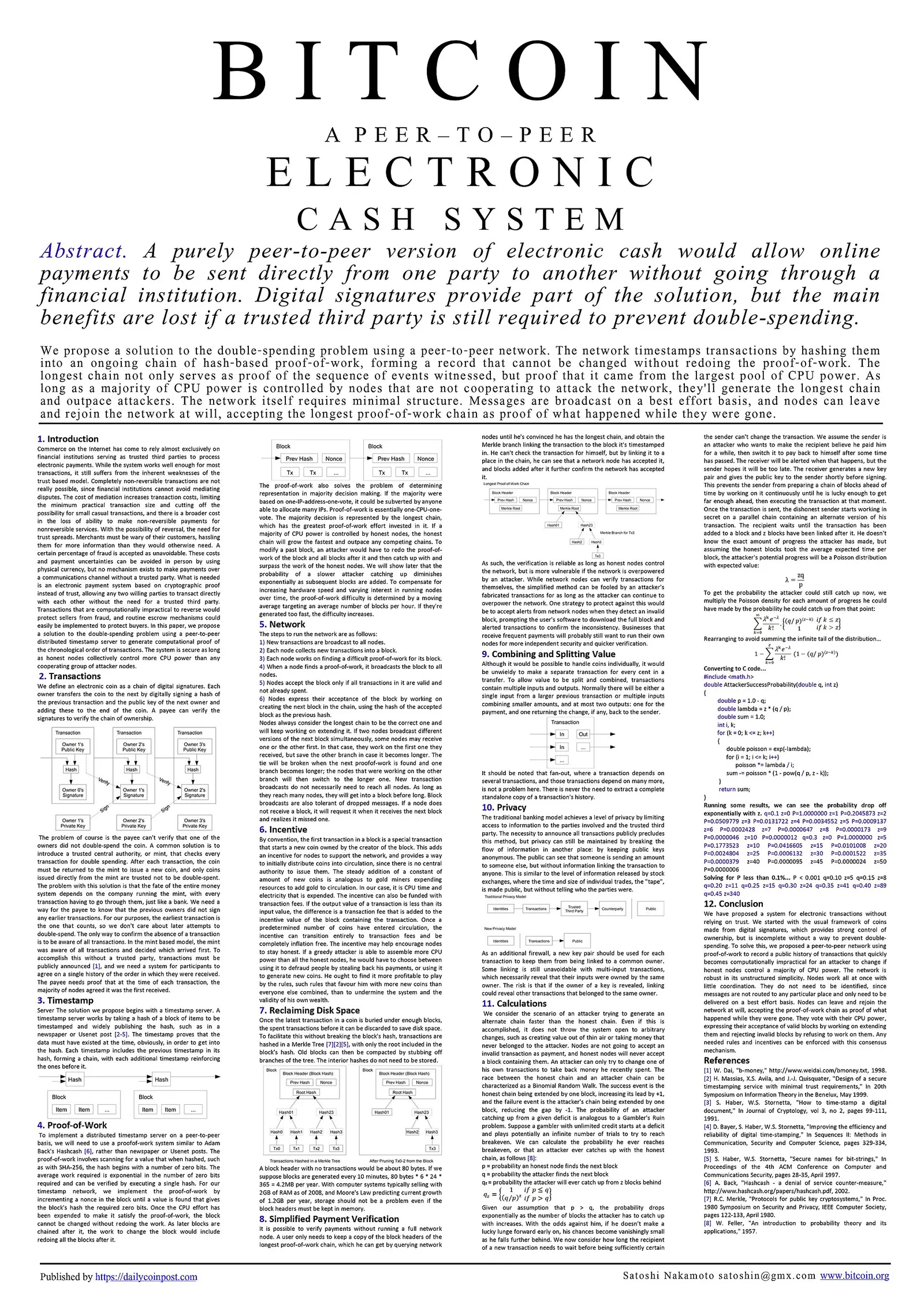
On the thirty-first of October 2008, six weeks after the bank Lehman Brothers went bankrupt and the world financial system was left hanging over the abyss, a cryptography mailing list received a message from a stranger. “I’ve been working on a new electronic cash system that’s fully peer-to-peer, with no trusted third party,” wrote Satoshi Nakamoto, attaching a link to a nine-page paper. The list’s subscribers had seen dozens of such projects in their lives and replied politely and wearily. One of the first replies began by saying that the world very much needed such a system, and immediately added that in its current form it did not seem likely to scale.
There was almost nothing new in the nine pages. Proof of work came from Adam Back’s Hashcash, the idea of money kept by the whole network from Wei Dai’s b-money, and Satoshi honestly cited both. Digital signatures, hash functions and peer-to-peer networks were by then studied from textbooks. What was new was the way of putting these parts together so that strangers who don’t trust one another could agree among themselves which version of the shared record was correct.
This is how it worked. All participants in the network keep a copy of one and the same book, in which every payment since the very beginning is recorded. New payments are gathered into a batch, a block, and to attach it to the book you have to solve a computational puzzle, like the one Back invented against spam, only much harder. The puzzle is tuned so that a solution is found on average once every ten minutes across the whole network, and whoever finds it first gets new coins as a reward. It amounts to a lottery where tickets are bought with electricity. Each next block refers to the previous one, and if two participants find a solution at the same time, the network eventually chooses the chain on which the most work has been spent.
After sign-in
The rest of the book is for signed-in readers
Sign in with INITE or create an account. It takes a minute, and the book opens right here.