06
Where to Cut
 archive
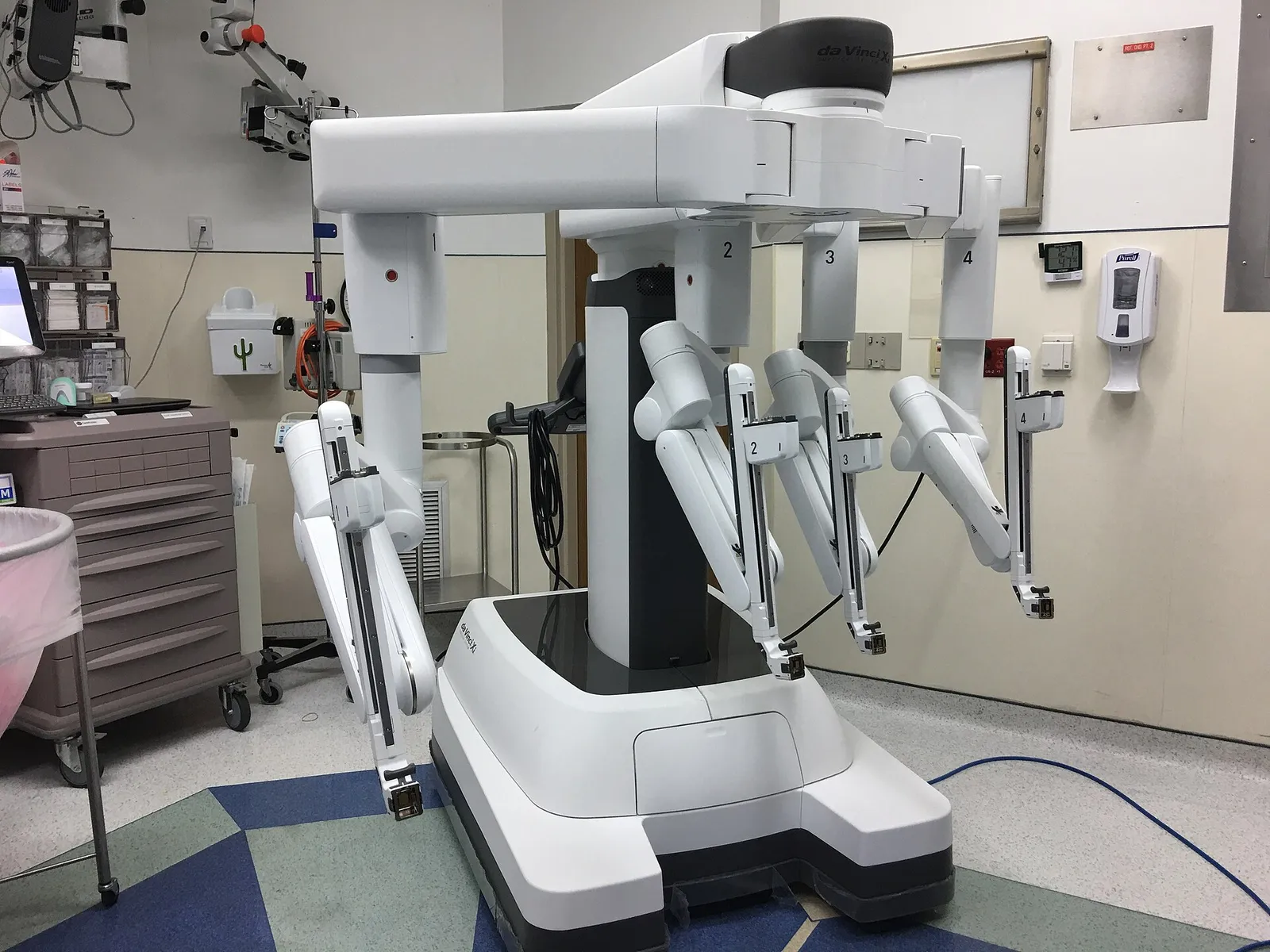
In 2000 the US Food and Drug Administration approved the da Vinci surgical robot for clinical use, and since then such robots have taken part in millions of operations around the world. It works like this: the patient lies on the table, several thin mechanical arms with instruments hang over him, and the surgeon sits a few metres away at a console that looks like a very expensive arcade machine, peering into eyepieces that show the operating field in three dimensions and magnified many times. The surgeon moves the handles and the robot repeats the movements, but repeats them better: the human hand constantly trembles at a rate of several oscillations per second, and the robot filters that tremor out; a three-centimetre movement of the wrist the robot can turn into a one-centimetre movement of the instrument, so that fine work becomes large and precise. The robot does not tire in the fourth hour of an operation and does not scratch its nose.
Deciding where to cut, however, is something the robot has never taken on and does not take on. In more than twenty years it has occurred to nobody that if you put a da Vinci in a district hospital, the orderly at the console will become a surgeon. The robot makes the hand more precise, while the knowledge of what to do with that hand stays with the person who spent ten years learning it.
This analogy came to me on the tenth of September 2025, when I was working out what to teach at INITE Education at all now that vibe coding had appeared. The difficulty lay in the definition of the profession itself: teaching people to write code that a machine can already write looked strange, and what to teach instead was unclear. By then I was thoroughly annoyed by the widespread idea that a good model turns a person with no engineering experience into a developer. The thought I arrived at went roughly like this: AI can already cut and stitch, and the problem is that someone has to know what to cut off where and where to stitch it on. A surgical robot does not turn a random person into a surgeon, and nobody expects it to. It holds the instrument more precisely than a hand, does not tire, shows a magnified picture, damps the tremor and carries out movements with inhuman accuracy, and still someone has to understand where to cut, what must under no circumstances be touched, and what then gets joined to what. The same thing is happening to code now.
After sign-in
The rest of the book is for signed-in readers
Sign in with INITE or create an account. It takes a minute, and the book opens right here.